AI in Construction
AI in Construction Project Controls: How Artificial Intelligence Is Reshaping the Industry (2026 Guide)
By Ahmed Elsamahy • • 14 min read
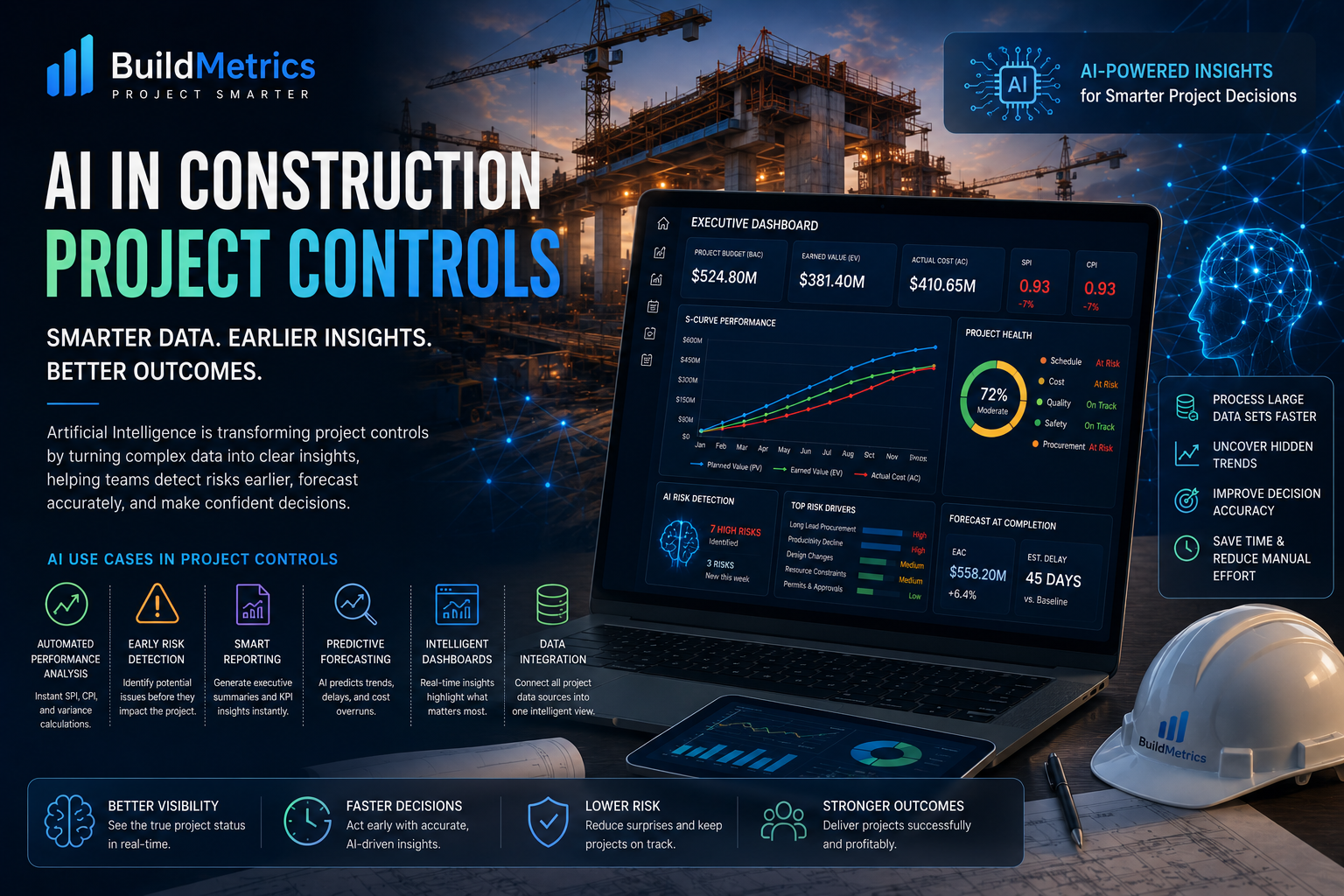
Introduction
Construction projects are becoming too complex for traditional project controls workflows.
Modern projects generate enormous amounts of data every week:
- Schedule updates
- Cost reports
- Procurement logs
- Site progress
- Productivity metrics
- Risk registers
- Executive dashboards
- Daily reports
- Change orders
Yet despite this massive amount of information:
👉 Many project teams still rely heavily on manual reporting and spreadsheet-based analysis.
This creates a major problem.
Project controls teams spend more time:
- Collecting data
- Formatting reports
- Reconciling spreadsheets
- Updating dashboards
Than actually analyzing project performance.
This is exactly why Artificial Intelligence (AI) is beginning to transform construction project controls.
AI is not replacing planners, cost engineers, or PMOs.
Instead:
👉 It is helping teams process project data faster, identify risks earlier, and improve decision-making.
In this guide, we will break down:
- What AI in project controls actually means
- Where AI creates the biggest impact
- Real-world use cases
- Common misconceptions
- Limitations of AI in construction
- And how modern project controls teams are beginning to adopt AI-driven workflows
What Is AI in Construction Project Controls?
AI in project controls refers to using intelligent systems to analyze project data and support faster, more accurate decision-making.
Instead of manually reviewing thousands of activities or cost records:
AI systems can:
- Detect trends
- Identify anomalies
- Forecast risks
- Generate insights
- Highlight critical issues automatically
The goal is not automation for the sake of automation.
The goal is:
👉 Better visibility and earlier decision support.
Why Construction Is Ready for AI
Construction generates huge amounts of structured and semi-structured data.
Examples include:
- Primavera schedules
- Cost reports
- BOQs
- Procurement trackers
- Progress updates
- RFIs
- Site reports
- Safety logs
- Quality records
Historically:
Most of this data remained fragmented and underutilized.
AI changes that.
Modern systems can now analyze relationships across multiple project datasets simultaneously.
The Biggest Problem in Traditional Project Controls
Traditional workflows are heavily manual.
In many organizations:
Teams spend days every reporting cycle:
- Updating Excel files
- Preparing PowerPoint presentations
- Reconciling data inconsistencies
- Creating executive summaries manually
By the time reporting is completed:
👉 The project status may already have changed.
This creates reactive management instead of proactive control.
Where AI Creates the Biggest Value
1. Automated Performance Analysis
AI can automatically analyze:
- SPI trends
- CPI trends
- Cost variances
- Schedule deterioration
- Progress anomalies
Instead of manually calculating performance indicators every cycle.
This significantly reduces reporting effort.
2. Early Risk Detection
One of the biggest advantages of AI is identifying risks earlier.
AI systems can detect patterns such as:
- Declining productivity
- Delayed procurement behavior
- Unusual cost trends
- Repeated schedule slippage
- Contractor performance deterioration
Often before teams fully recognize the issue themselves.
3. Executive Reporting Automation
Executive reporting is one of the most time-consuming PMO activities.
AI can help generate:
- Executive summaries
- KPI narratives
- Risk highlights
- Forecast commentary
- Performance explanations
This allows project controls teams to focus more on analysis instead of formatting reports manually.
4. Forecasting and Predictive Analytics
Traditional project controls are often reactive.
AI introduces predictive capability.
Modern systems can forecast:
- Likely completion delays
- Budget overruns
- Procurement risks
- Performance deterioration
- Cash flow trends
This helps organizations act earlier.
5. Intelligent Dashboarding
AI-driven dashboards can dynamically highlight:
- Critical issues
- High-risk packages
- Negative performance trends
- Delayed milestones
- Areas requiring management attention
Instead of forcing executives to manually interpret massive reports.
Real Example: Traditional vs AI-Driven Reporting
Imagine a project with:
- 12,000 schedule activities
- Multiple contractors
- Weekly reporting cycles
- Procurement complexity
- Large cost datasets
Traditional workflow:
- Manual progress consolidation
- Excel calculations
- PowerPoint preparation
- Hours of reconciliation
- Delayed reporting
AI-assisted workflow:
- Automatic KPI calculations
- Instant trend detection
- Real-time performance dashboards
- Automated executive summaries
- Faster risk visibility
The difference becomes massive at scale.
Why AI Will Not Replace Project Controls Engineers
One of the biggest misconceptions is:
"AI will replace planners and project controls teams."
This is unlikely.
Project controls involves:
- Judgment
- Strategy
- Contract interpretation
- Stakeholder communication
- Recovery planning
- Decision-making
AI cannot fully replace these responsibilities.
Instead:
AI acts more like:
👉 An intelligent analytical assistant.
The strongest project controls teams in the future will likely combine:
- Human expertise
- AI-assisted analytics
- Automated workflows
Together.
The Real Limitation of AI in Construction
AI is only as strong as the underlying project data.
Poor data creates poor insights.
Common problems include:
- Inaccurate progress updates
- Weak baseline schedules
- Inconsistent cost coding
- Fragmented reporting systems
- Manual data entry errors
Without reliable data:
Even advanced AI systems become less effective.
Why Baseline Quality Still Matters
AI cannot fix a fundamentally broken schedule baseline.
If the original baseline contains:
- Unrealistic durations
- Broken logic
- Artificial constraints
- Weak procurement integration
Then forecasting accuracy suffers.
This is why strong project controls fundamentals still matter enormously.
👉 Read our full baseline scheduling guide here.
AI and Earned Value Management (EVM)
AI is increasingly being integrated with EVM systems.
Modern AI-driven platforms can automatically analyze:
- SPI deterioration
- CPI trends
- Forecasted EAC movement
- Productivity decline
- Variance escalation
This helps organizations detect performance issues earlier.
👉 Read our full EVM guide here.
Why Spreadsheet-Based Project Controls Are Becoming Unsustainable
Many organizations still rely heavily on Excel-driven reporting workflows.
This creates growing limitations:
- Version conflicts
- Slow reporting cycles
- Manual reconciliation
- Limited scalability
- Weak forecasting visibility
As projects become larger and more data-intensive:
👉 Manual workflows become increasingly difficult to sustain.
What Leading Organizations Are Doing Differently
High-performing project organizations are increasingly investing in:
- AI-assisted reporting
- Integrated dashboards
- Automated KPI tracking
- Real-time analytics
- Predictive forecasting
- Portfolio visibility systems
The goal is not simply digitization.
The goal is:
👉 Faster and smarter decision-making.
The Future of AI in Construction Project Controls
Over the next several years, AI will likely become deeply integrated into:
- Schedule analysis
- Cost forecasting
- Risk management
- Executive reporting
- Productivity analytics
- Procurement tracking
- Portfolio management
The industry is gradually moving from:
Reactive reporting → Predictive project intelligence.
Common AI Myths in Construction
Myth #1 — AI Solves Everything Automatically
False.
AI improves analysis.
But it still depends on:
- Strong data
- Proper controls
- Human oversight
Myth #2 — AI Eliminates the Need for Planning
False.
Planning fundamentals remain critical.
AI enhances project controls.
It does not replace execution strategy.
Myth #3 — AI Is Only for Mega Projects
False.
Even medium-sized projects can benefit significantly from:
- Automated reporting
- KPI tracking
- Trend analysis
- Forecast visibility
A Better Approach to Modern Project Controls
The strongest project organizations today increasingly combine:
- Traditional project controls expertise
- AI-assisted analytics
- Integrated reporting systems
- Real-time visibility
- Executive dashboards
This creates:
- Faster decisions
- Earlier risk detection
- Stronger forecasting
- Improved stakeholder visibility
Final Thoughts
AI is not a future concept anymore.
It is already beginning to reshape project controls workflows across the construction industry.
Organizations that adopt AI strategically can gain major advantages in:
- Reporting speed
- Risk visibility
- Forecasting accuracy
- Executive decision-making
- PMO efficiency
The goal is not replacing project controls professionals.
The goal is empowering them with better intelligence.
Related Articles
- Earned Value Management (EVM): Full Guide with Real Project Examples
- Executive Reporting in Project Controls
- How to Build a Reliable Schedule Baseline for Infrastructure Projects
- Cost Control Best Practices in Construction
Ready to Modernize Project Controls?
BuildMetrics AI helps project teams:
- Automate KPI tracking
- Analyze SPI/CPI instantly
- Generate executive dashboards
- Detect project risks earlier
- Improve forecasting visibility
👉 Explore smarter AI-powered project controls with BuildMetrics AI.