Cost Control
Cost Control Best Practices in Construction: How Top Teams Prevent Budget Overruns (2026 Guide)
By Ahmed Elsamahy • • 12 min read
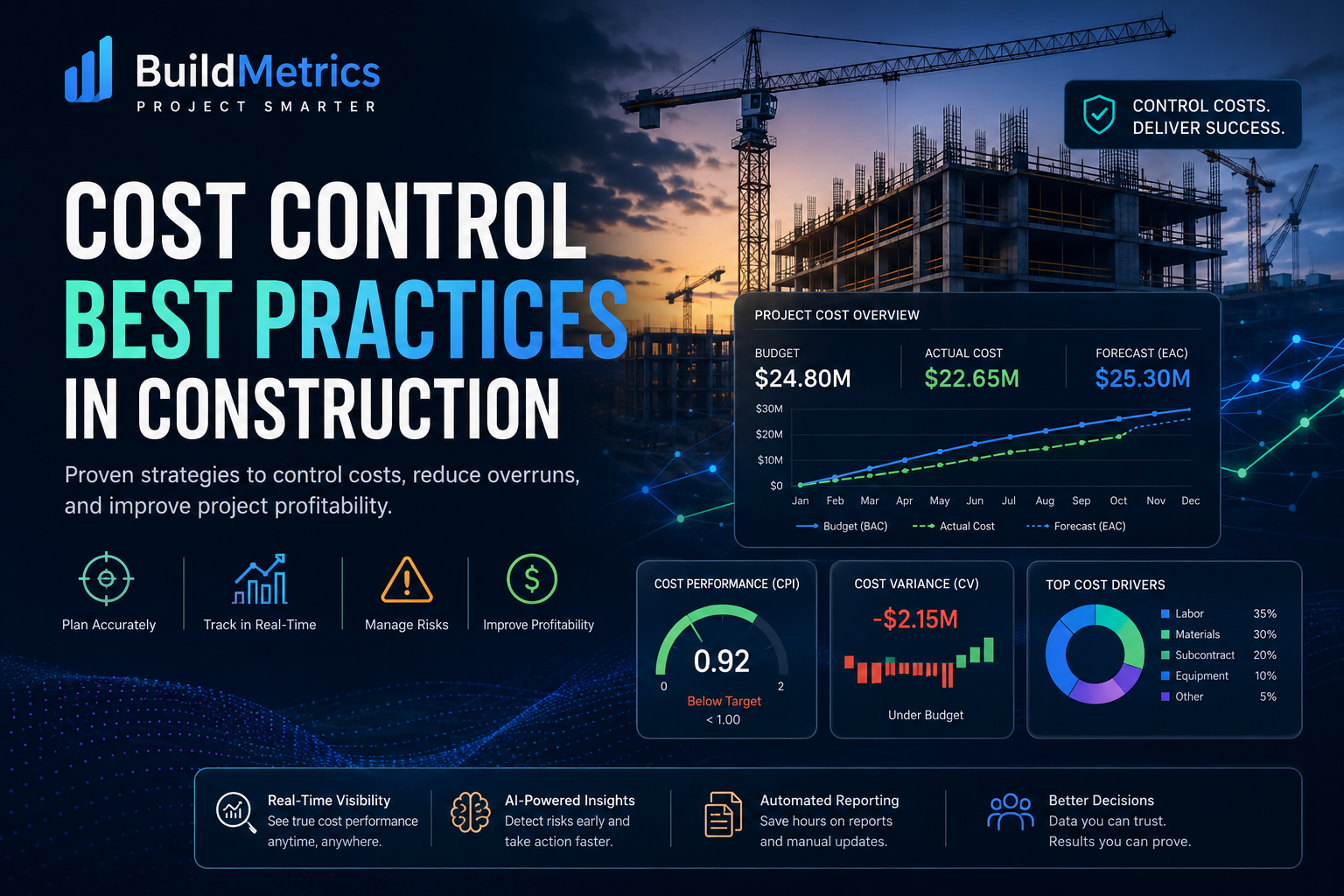
Most construction projects do not fail because of poor execution.
They fail because teams lose control of cost visibility.
At the beginning of a project, everything looks manageable: the budget is approved, procurement plans are prepared, progress reports look acceptable, and cash flow forecasts seem realistic.
But slowly, small deviations begin to accumulate. A delayed material delivery. A subcontractor variation. An underestimated activity. An optimistic progress update.
And before anyone notices, the project is already over budget.
This is why cost control is not just an accounting process — it is one of the most critical decision-making systems in modern construction projects.
Key Takeaway: Cost overruns rarely come from a single event. They emerge from many small, untracked deviations that compound over time. The teams that win are the teams that catch drift early.
In this guide, we break down what construction cost control actually means, why most teams struggle with it, the most effective best practices, common mistakes to avoid, and how modern project teams are moving beyond Excel-based reporting.
What Is Cost Control in Construction?
Construction cost control is the process of monitoring, managing, and forecasting project costs throughout the project lifecycle. The goal is simple: deliver the project within the approved budget.
But in real projects, cost control is much more than tracking invoices or comparing budget vs actual. Effective cost control requires teams to continuously connect budget, progress, productivity, procurement, commitments, forecasts, variations, and risks.
Without this connection, reports become reactive instead of predictive.
Why Most Construction Projects Lose Cost Control
The biggest misconception in construction is this: "If we track actual costs monthly, we''re controlling cost." That is not true.
In many projects, actual costs arrive late, progress updates are inaccurate, forecasts are overly optimistic, and procurement commitments are disconnected from reporting.
As a result, the project team often discovers cost overruns too late — and by that point, recovery becomes difficult.
The Real Cost Control Problem
The issue is rarely the lack of data. The issue is fragmentation.
Most construction teams still operate with the schedule in Primavera P6, costs in Excel, procurement in ERP systems, progress updates in emails or spreadsheets, and executive reporting in PowerPoint.
This creates massive inefficiencies. Instead of analyzing project performance, teams spend their time collecting information, formatting reports, reconciling numbers, and updating spreadsheets manually.
Best Practice #1 — Establish a Realistic Cost Baseline
Everything starts with the baseline. If the original budget is unrealistic, every cost report after that becomes misleading.
A strong cost baseline should include a detailed BOQ structure, realistic resource pricing, procurement assumptions, productivity assumptions, risk allowances, and escalation considerations.
Common Mistake: Many projects use aggressive estimates simply to win bids. This creates immediate pressure on execution teams, and eventually cost overruns become almost unavoidable.
Best Practice #2 — Link Cost to Progress
This is where many projects fail. Cost alone means very little without progress.
Spending $2 million sounds acceptable — but what did the project actually achieve with it?
This is why modern project controls teams rely heavily on Earned Value Management (EVM). By connecting Planned Value (PV), Earned Value (EV), and Actual Cost (AC), teams can understand cost efficiency, schedule efficiency, forecasted overruns, and performance trends.
Key Takeaway: Without linking cost to physical progress, cost reporting only describes spending — not performance. EVM remains the most reliable framework for connecting the two.
Best Practice #3 — Track Commitments, Not Just Actual Costs
One of the biggest cost control mistakes is focusing only on invoices already paid. By the time costs become "actual", the financial exposure already exists.
Strong cost control systems track purchase orders, subcontract commitments, pending variations, and forecast liabilities. This gives teams early visibility.
Real Project Example: Imagine actual spent cost is $4M against an approved budget of $5M. At first glance, everything seems fine. But procurement commitments are $2M and a pending variation is $600K. The reality is the project is already heading toward overrun. Without commitment tracking, management may discover this far too late.
Best Practice #4 — Forecast Continuously
Cost control is not about reporting history. It is about predicting the future.
Teams should continuously update Estimate at Completion (EAC), forecast cash flow, forecast productivity trends, and forecast procurement exposure.
Common Forecasting Mistake: Many teams simply assume future work will perform exactly like planned. In reality, productivity changes, risks evolve, market prices fluctuate, and delays impact efficiency. Forecasting must reflect reality.
Best Practice #5 — Automate Reporting Wherever Possible
Manual reporting is one of the biggest hidden costs in project controls.
In many PMOs, teams spend hours updating spreadsheets, days preparing executive reports, and significant effort reconciling inconsistencies. And after all that effort, the report is already outdated.
Leading project controls teams are shifting toward automated dashboards, real-time reporting, integrated schedule and cost systems, and AI-powered insights. Instead of waiting for monthly reporting cycles, teams can identify cost drift, productivity decline, delayed procurement, and schedule impact almost instantly.
Best Practice #6 — Focus on Trends, Not Single Numbers
Many teams overreact to isolated numbers. A CPI of 0.99 this month, on its own, means very little.
What matters is the trend. Is performance improving, or consistently deteriorating? Trend analysis is far more valuable than isolated metrics.
Key Takeaway: A single CPI or SPI value is noise. A trend over 3–6 reporting periods is signal. Always make decisions on direction, not snapshots.
Best Practice #7 — Improve Executive Visibility
One of the biggest gaps in construction reporting is communication.
Executives do not want 100-page reports, complicated spreadsheets, or technical jargon. They want clarity, risks, forecasts, and decision points.
Strong cost control systems help convert technical data into executive-level insight.
Why Excel Is Becoming a Major Limitation
Excel remains heavily used in construction. But modern projects generate massive datasets, frequent updates, complex reporting cycles, and multi-source information.
This creates version control issues, manual errors, delayed reporting, and weak visibility. Excel is still useful — but relying on it as the primary cost control system is becoming increasingly difficult.
How AI Is Changing Construction Cost Control
Artificial Intelligence is beginning to transform project controls. Modern systems can now detect cost anomalies automatically, identify risk patterns, forecast performance trends, generate executive summaries instantly, and highlight critical issues earlier.
The future of project controls is moving from reactive reporting to predictive insight.
A Better Approach to Construction Cost Control
The strongest project teams today are not necessarily the teams with the most reports. They are the teams with faster visibility, better forecasting, connected data, and faster decisions.
This is exactly why platforms like BuildMetrics AI are emerging. Instead of manually preparing reports every cycle, teams can track performance automatically, monitor SPI and CPI instantly, generate executive dashboards, and connect cost, schedule, and progress in one place.
Final Thoughts
Construction cost control is no longer just about tracking expenses. It is about visibility, forecasting, early warning signals, and decision-making.
The earlier teams detect problems, the higher the probability of recovery. The teams that continue relying entirely on fragmented spreadsheets and delayed reporting will increasingly struggle to keep up.