Reporting
Executive Reporting in Project Controls: How Top Teams Deliver Clear Project Visibility (2026 Guide)
By Ahmed Elsamahy • • 12 min read
Introduction
Most project reports fail for one simple reason:
👉 They contain data instead of insight.
In many construction and infrastructure projects:
Teams spend days preparing reports
PMOs build massive Excel files
Schedules are exported from Primavera P6
Cost data comes from multiple systems
Progress updates are collected manually
And after all this effort:
Executives still leave meetings asking:
"So… what is the actual project status?"
This is the hidden crisis in project controls.
Most organizations are producing reports.
But very few are delivering executive visibility.
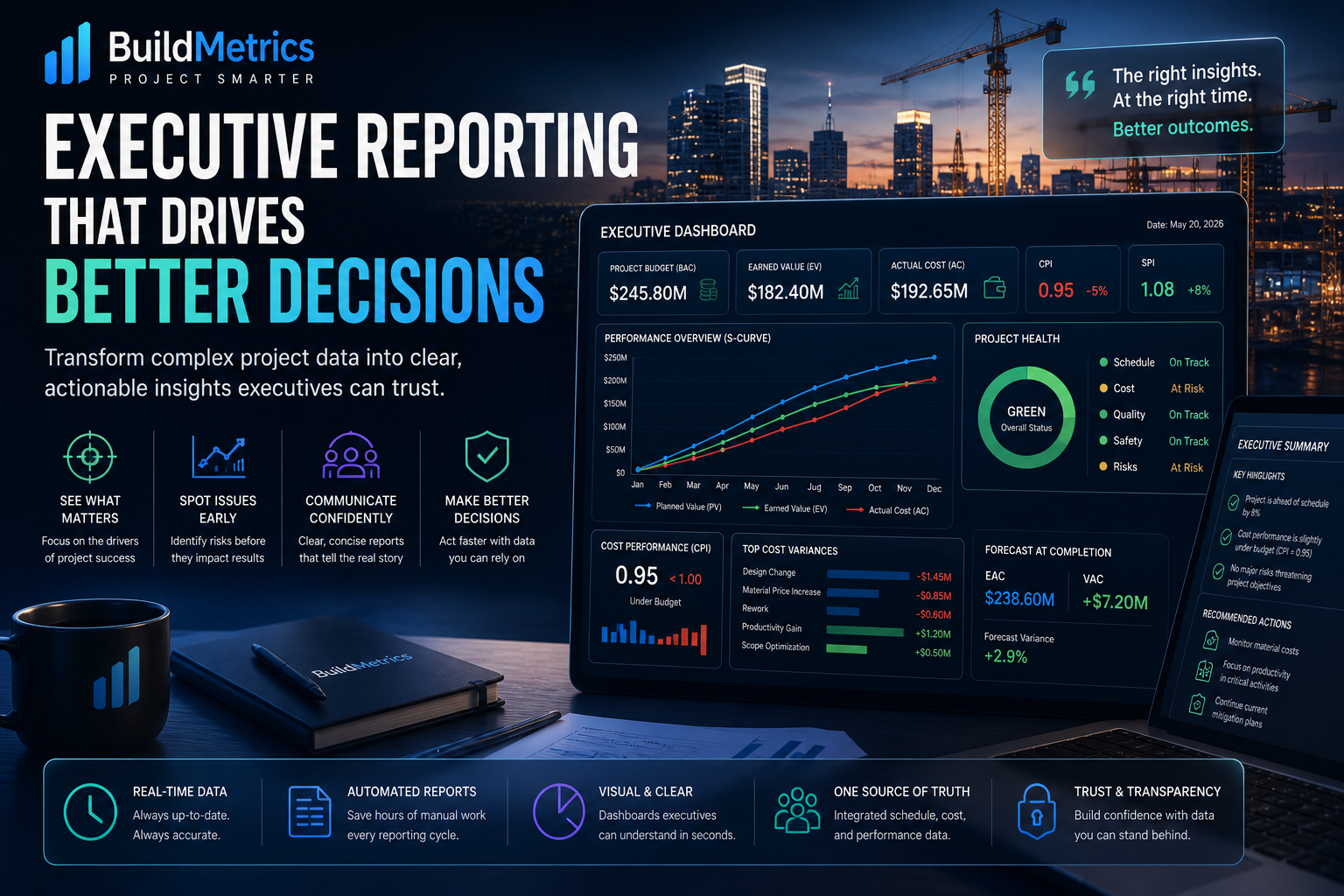
This is exactly why executive reporting has become one of the most critical functions in modern project controls.
The goal is not to produce more charts.
The goal is to help decision-makers:
Understand risks faster
Identify problems earlier
Make better decisions
Take action before projects deteriorate
In this guide, we will break down:
What executive reporting actually means
Why most project reports fail
The best practices used by leading PMOs
What executives really care about
Common reporting mistakes
And how AI is beginning to transform project reporting workflows
What Is Executive Reporting in Project Controls?
Executive reporting is the process of converting project data into high-level decision-making insight.
It helps senior stakeholders quickly understand:
Overall project health
Schedule performance
Cost performance
Risks and issues
Forecasts
Critical decisions required
Executive reporting is NOT:
Dumping raw data into PowerPoint
Exporting Primavera screenshots
Sending massive spreadsheets
Instead:
It is about clarity.
The best executive reports simplify complexity.
Why Executive Reporting Matters More Than Ever
Modern projects generate enormous amounts of data.
A single mega project may contain:
Thousands of activities
Multiple contractors
Procurement packages
Cost reports
Risk registers
Change orders
Progress updates
Without structured executive reporting:
👉 Leadership loses visibility.
And when visibility disappears:
Decisions become reactive
Risks escalate silently
Delays worsen
Cost overruns grow unnoticed
The Biggest Executive Reporting Problem
Most PMOs confuse:
"More information" with "better reporting."
This leads to reports that are:
Too technical
Too long
Too detailed
Too fragmented
Too slow to prepare
Executives do not want:
80-page reports
Detailed activity logic
Thousands of rows of data
They want:
The real status
The biggest risks
Forecasted outcomes
Recommended actions
What Executives Actually Care About
At senior management level, most stakeholders focus on five core questions:
1. Are We On Schedule?
This is usually the first question.
Executives want to understand:
Is the completion date still achievable?
Are delays increasing?
What is driving schedule slippage?
Strong reports summarize:
Critical path impact
SPI trends
Major delayed work fronts
Recovery status
2. Are We Within Budget?
Executives rarely want raw cost spreadsheets.
They want:
Cost trend visibility
Forecasted overruns
CPI trends
Procurement exposure
Commitment tracking
The focus is not history.
The focus is:
👉 "Where is this project heading?"
3. What Are the Biggest Risks?
Strong executive reports identify:
High-impact risks
Delayed procurement items
Major subcontractor issues
Resource shortages
Regulatory concerns
The best reports prioritize risks instead of overwhelming stakeholders with hundreds of minor issues.
4. What Decisions Are Required?
This is where many reports fail.
A report should not only describe problems.
It should support decisions.
Example:
Instead of saying:
"Procurement is delayed."
A stronger executive report would say:
"Long-lead material delay may impact commissioning milestone by 21 days unless procurement acceleration is approved this week."
That creates actionable visibility.
5. What Happens Next?
Executives care deeply about forecasting.
They want to understand:
Future risks
Trend direction
Likely outcomes
Confidence level
Modern reporting is increasingly moving from:
Historical reporting → Predictive reporting.
Why Most Project Reports Fail
There are several recurring reporting problems in project controls.
Problem #1 — Too Much Data
Large reports often create confusion instead of clarity.
Many PMOs include:
Excessive tables
Detailed logs
Irrelevant screenshots
Low-value metrics
The result:
👉 Important issues become buried.
Problem #2 — Manual Reporting Cycles
In many organizations:
Teams spend:
Days collecting information
Hours formatting PowerPoint slides
Significant effort reconciling data
By the time the report is finalized:
👉 The information is already outdated.
Problem #3 — Inconsistent Data Sources
Project data often exists across:
Primavera P6
Excel
ERP systems
Procurement systems
Emails
Manual trackers
This fragmentation creates:
Conflicting numbers
Weak visibility
Slow reporting
Low stakeholder confidence
Problem #4 — Weak Narrative
Many reports present numbers without explanation.
Example:
SPI = 0.82
CPI = 0.91
But what does that actually mean?
Executives need context.
Strong reporting explains:
What happened
Why it happened
What the impact is
What action is recommended
Best Practices for Executive Reporting
Best Practice #1 — Focus on Trends, Not Snapshots
Single numbers are rarely meaningful.
Trend visibility matters more.
Executives should quickly understand:
Is performance improving?
Is productivity deteriorating?
Are risks accelerating?
Trend analysis creates strategic visibility.
Best Practice #2 — Use Visual Reporting
Modern executive reporting relies heavily on visualization.
Examples include:
S-curves
KPI dashboards
Trend charts
Heat maps
Forecast graphs
Risk matrices
Visual reporting reduces interpretation time dramatically.
Best Practice #3 — Prioritize Critical Information
The best reports highlight:
The top 3–5 project issues
The biggest risks
The most urgent decisions
Executives do not need every detail.
They need prioritization.
Best Practice #4 — Automate Reporting Where Possible
Manual reporting creates major inefficiencies.
Leading organizations increasingly automate:
KPI updates
Dashboard generation
Executive summaries
EVM calculations
Progress tracking
This allows PMOs to spend more time analyzing performance instead of preparing reports.
The Role of Earned Value Management (EVM) in Executive Reporting
EVM remains one of the most powerful reporting frameworks in project controls.
Metrics like:
SPI
CPI
SV
CV
EAC
Help executives understand:
Schedule efficiency
Cost efficiency
Forecasted outcomes
👉 Read our full EVM guide here:
https://www.buildmetricsai.com/blog/evm-full-guide-real-project-examples-2026
Why Executive Reporting Is Moving Beyond Excel
Excel still dominates many PMOs.
But modern projects require:
Faster reporting
Real-time visibility
Multi-source integration
Automated forecasting
This creates major limitations for spreadsheet-based workflows.
Common Excel reporting problems include:
Version conflicts
Formula errors
Manual updates
Slow reporting cycles
Weak scalability
How AI Is Changing Executive Reporting
Artificial Intelligence is beginning to transform project reporting.
Modern AI-powered systems can:
Generate executive summaries automatically
Detect performance anomalies
Highlight high-risk areas
Forecast deteriorating trends
Recommend actions based on data patterns
This allows project teams to move from:
Reactive reporting → Intelligent decision support.
A Better Approach to Executive Reporting
The strongest PMOs today are not necessarily producing the biggest reports.
They are producing:
Faster insights
Cleaner dashboards
Better forecasts
More actionable reporting
This is why platforms like BuildMetrics AI are emerging.
Instead of manually preparing reports every cycle:
Teams can:
Connect cost, schedule, and progress data
Generate executive dashboards instantly
Monitor SPI/CPI automatically
Track trends continuously
Deliver clearer stakeholder visibility
Real-World Reporting Shift Happening Across the Industry
The construction industry is slowly moving toward:
Live dashboards
Automated KPIs
Portfolio-level visibility
AI-assisted reporting
Predictive project controls
Organizations that modernize reporting earlier will gain major advantages in:
Decision-making speed
Risk visibility
PMO efficiency
Stakeholder confidence
Final Thoughts
Executive reporting is no longer just about presenting information.
It is about enabling better decisions.
The best reports:
Simplify complexity
Surface critical risks
Improve visibility
Support action
As projects become larger and more data-intensive:
The organizations that continue relying entirely on fragmented spreadsheets and manual reporting workflows will increasingly struggle.
Related Articles
Earned Value Management (EVM): Full Guide with Real Project Examples
Cost Control Best Practices in Construction
Baseline Project Schedule: Step-by-Step Guide
How AI Is Transforming Project Controls
Ready to Modernize Executive Reporting?
If your team is still spending days preparing executive reports manually:
👉 Explore how BuildMetrics AI helps project teams automate dashboards, executive reporting, EVM tracking, and project visibility in real time.