AI in Construction
The Hidden Cost of Learning Curve on Mega-Projects — What No Vendor Tells You
By Ahmed Alsamahi • • 8 min read
By Ahmed Alsamahi | Founder, BuildMetricsAI | 14 Years in Project Controls
Every construction software vendor will show you an ROI calculator.
They'll tell you how much time their tool saves. How many delays it prevents. How many millions it protects on a $500M project.
What they will never show you is the cost of getting your team to actually use it.
That number — the learning curve cost — is where most of the promised ROI quietly disappears.
The Graveyard Nobody Talks About
The construction industry is littered with the graves of brilliant software that expected engineers to become data entry clerks.
Primavera plugins that required three days of training before a single schedule could be updated. Dashboard tools that demanded engineers log in separately from their existing workflow. AI platforms that needed clean, structured data — on a live $200M project where data is anything but clean.
Each of these tools had a compelling pitch. Each had a demo that looked impressive. And each was quietly abandoned by Week 6 when the project team went back to their Excel files.
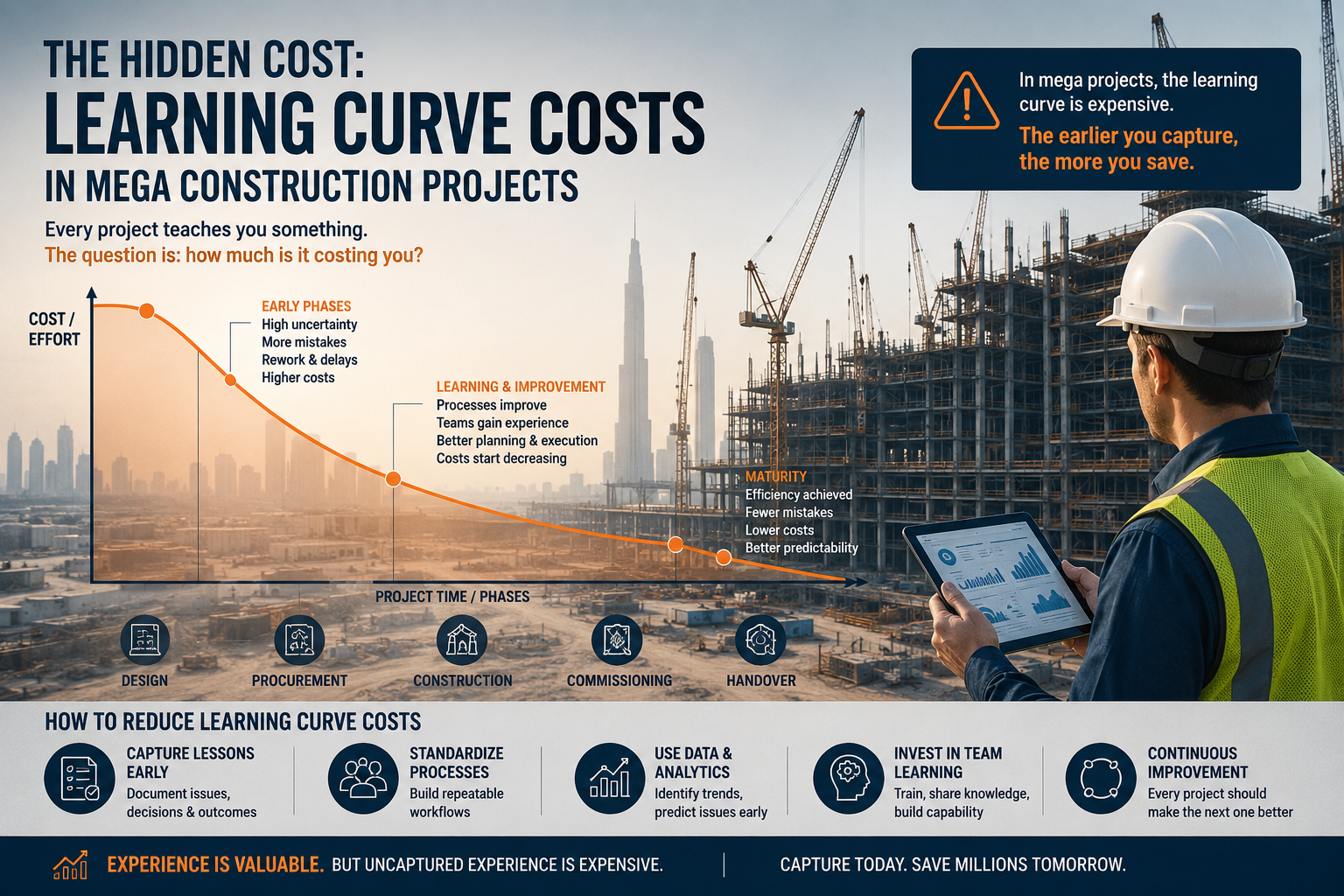
This isn't a technology problem. It's a learning curve problem. And on mega-projects, the cost of that curve is enormous.
What the Learning Curve Actually Costs on a Mega-Project
Let's be specific about where the money goes.
1. Productivity Loss During Transition
When a project controls engineer on a $1B infrastructure project spends two weeks learning a new system, they're not just spending two weeks on training. They're spending two weeks with reduced output on a live project where every delay in reporting creates downstream risk.
On a project with 10 project controls engineers, two weeks of reduced productivity at 40% efficiency loss equals roughly 400 person-hours of lost work. At $80/hour loaded cost, that's $32,000 — before a single license fee has been paid.
2. Data Migration and Integration Time
Getting existing project data — schedules, BOQs, procurement logs, progress reports — into a new system is never as simple as vendors claim. On a live mega-project, data is messy, inconsistent, and often owned by multiple parties across contractor, consultant, and owner teams.
A realistic data migration on a complex infrastructure project takes 3–8 weeks. During that window, the team is running two systems simultaneously, which doubles the reporting burden and introduces the risk of data inconsistency.
3. The Cognitive Overload Tax
The bottleneck on large projects is never a lack of data. It's cognitive overload.
Project managers on Giga-Projects are already managing programme interfaces, procurement approvals, design movements, subcontractor packages, and commercial claims — simultaneously. Adding a new tool to their daily battle rhythm doesn't reduce cognitive load. It increases it.
If your AI forces a project manager to alter their existing workflow just to feed the algorithm, the learning curve wins. The tool gets abandoned. And the cognitive overload was made worse, not better, by the implementation.
4. The Interpretation Gap — The Cost Nobody Measures
Here's the hidden cost that never appears in any vendor's ROI calculation:
Even when a new tool is successfully adopted, the interpretation layer often remains broken.
Two teams can receive the same risk signal from the same dashboard at the same time — and still respond in ways that carry completely different assumptions about urgency, impact, and required action.
Detection doesn't fail because signals are missing. It fails because the same signal doesn't lead to the same conclusion.
On UAE and GCC projects specifically, this plays out consistently: signals are visible early but fragmented across programme, procurement, approvals, design movement, and package interfaces. Each team can still defend its own piece, even while the overall commercial position is weakening.
The cost jump comes when those separate warnings finally collide under time pressure. By then, it's no longer just a controls issue. It's a recovery, credibility, and margin issue at the same time.
The Three-Layer Problem Vendors Ignore
The construction software industry has spent the last decade solving Layer 1: Detection.
Better dashboards. Faster reporting. More data points. AI that surfaces anomalies earlier than any human team could manually.
Layer 1 is valuable. But detection was never the full problem.
Layer 1: Detection — Can we see the signal early enough? Most AI tools are here. This gap is closing.
Layer 2: Interpretation — Can we ensure what's seen is understood the same way by all stakeholders? Almost no tool is designed for this. This is where alignment breaks.
Layer 3: Decision Integrity — Can we maintain consistent decision logic as the project context shifts? This layer is invisible until it fails. And when it fails, the project is usually already in crisis.
If Layer 2 isn't designed deliberately, Layer 1 just accelerates inconsistency. Better detection without shared interpretation logic doesn't reduce drift — it scales it.
What Near-Zero Learning Curve Actually Looks Like
The tools that survive on large projects share one design principle: the AI adapts to the engineer's existing workflow, not the other way around.
This means:
No new data entry. The tool reads what your team already produces — existing Excel schedules, BOQ files, procurement logs — without asking engineers to change how they work or maintain parallel data entry.
No parallel systems. A project controls engineer should be running their first meaningful output within hours of setup, not after a week of onboarding.
No behavior change required. The analysis and flags appear inside the reports your team already produces. The workflow doesn't expand — it becomes more intelligent.
Shared interpretation logic built in. The tool doesn't just surface a risk signal. It attaches context, impact probability, and response logic so that the same signal carries the same meaning for the contractor, the consultant, and the owner — before the first disagreement occurs.
The Real ROI Question
The right question to ask any construction software vendor isn't "What does your tool save us?"
It's: "What does it cost us to get to the point where it starts saving us anything?"
On a $50M project, the difference between catching a cascading delay in Week 2 versus Week 10 is the difference between a $50K fix and a $4M crisis. That ROI is real.
But if the learning curve, data migration, and interpretation gap costs you $300K before the tool is fully operational — you've already consumed a significant portion of that value before the AI has flagged a single anomaly.
The vendors who are honest about this are the ones worth talking to.
A Final Thought
Thirteen years in project controls taught me one thing about tools: the ones that survive aren't the most powerful ones.
They're the ones that disappear into the workflow.
The best project controls tool is the one your team uses every day without thinking about it — because it lives where they already work, reads what they already produce, and makes them more effective without making them do more.
That's the standard we're building BuildMetricsAI to meet.
If you're managing a project over $20M and want to see what near-zero learning curve project controls looks like on your actual data, you can start a free 14-day trial at BuildMetricsAI.com — no setup required, no data migration, no new workflows.