Planning
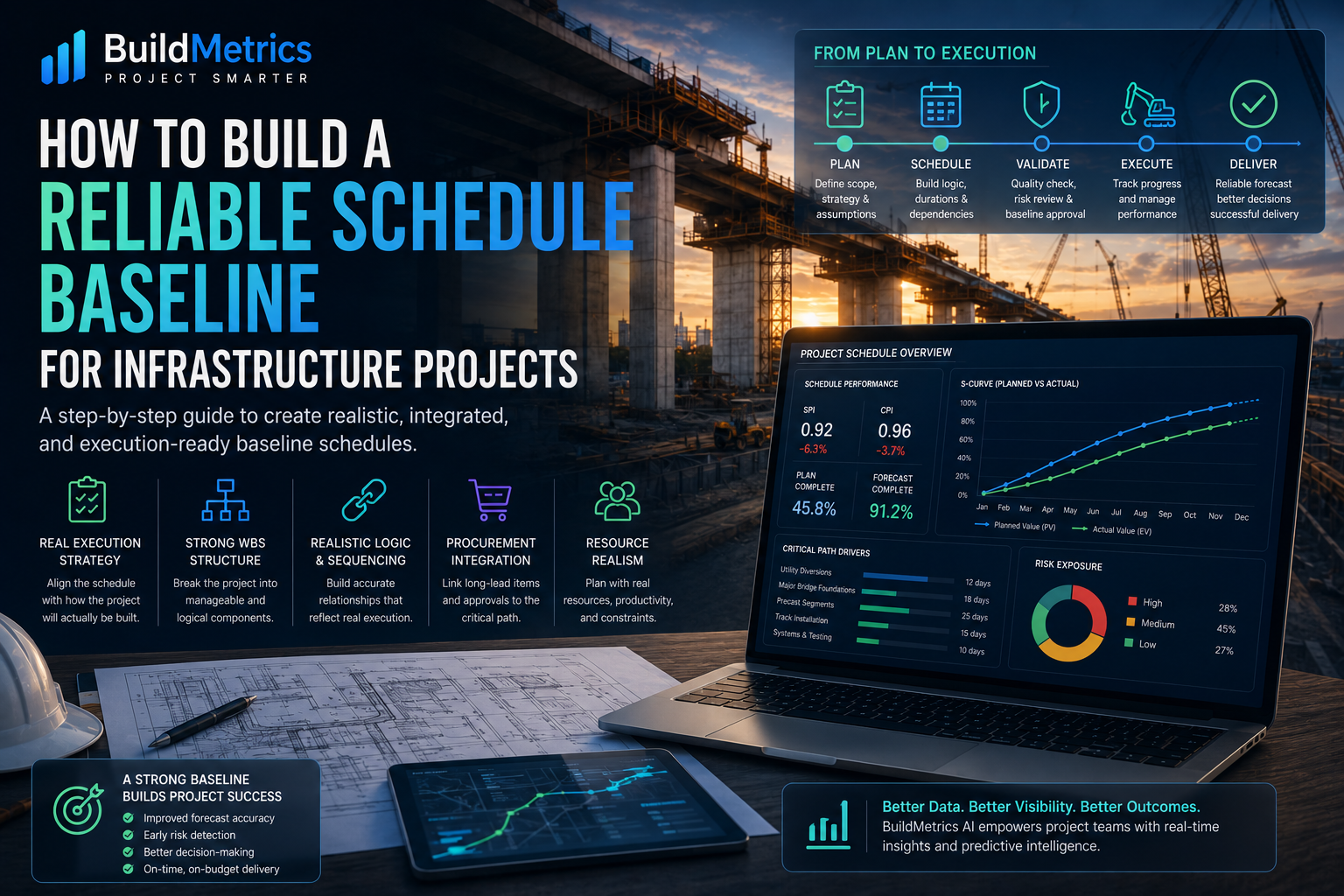
How to Build a Reliable Schedule Baseline for Infrastructure Projects (2026 Guide)
By Ahmed Elsamahy • • 14 min read
Introduction
Infrastructure projects rarely fail because of a single catastrophic event.
Most failures begin much earlier:
👉 At the planning stage.
A weak schedule baseline creates hidden instability across the entire project lifecycle.
At first, everything appears acceptable:
Milestones look achievable
Float appears healthy
Progress reports seem positive
Stakeholders feel confident
But months later:
Procurement starts slipping
Critical interfaces become chaotic
Contractors begin requesting extensions
Recovery plans multiply
Costs escalate rapidly
And suddenly the project loses control.
This happens constantly in:
Roads and highways
Rail projects
Airports
Utilities
Water infrastructure
Mega urban developments
Industrial infrastructure
The root cause is often the same:
👉 An unrealistic or poorly structured baseline schedule.
In this guide, we will break down:
What makes infrastructure scheduling uniquely difficult
How to build a reliable schedule baseline
Common mistakes infrastructure projects make
Why procurement and interfaces dominate infrastructure schedules
How leading project controls teams structure baseline planning
And how modern AI-driven project controls are improving schedule reliability
Why Infrastructure Scheduling Is Different
Infrastructure projects are fundamentally more complex than standard building projects.
They involve:
Large geographic areas
Multiple stakeholders
Utility interfaces
Government approvals
Environmental constraints
Long procurement cycles
Phased access
Massive subcontractor coordination
This creates extremely high scheduling complexity.
Unlike smaller vertical construction projects:
👉 Infrastructure schedules behave like interconnected ecosystems.
A delay in one package can trigger cascading impacts across the entire program.
What Is a Schedule Baseline?
A schedule baseline is the officially approved project schedule used to measure performance throughout execution.
It includes:
Planned activity durations
Logic relationships
Milestones
Critical path
Procurement sequencing
Resource assumptions
Planned completion dates
Once approved:
👉 The baseline becomes the reference point for project control.
Everything depends on it:
Progress tracking
EVM calculations
Delay analysis
Recovery planning
Executive reporting
Claims evaluation
Why Reliable Baselines Matter in Infrastructure Projects
Infrastructure projects often span:
Several years
Multiple contractors
Thousands of activities
Large procurement scopes
Without a strong baseline:
Visibility collapses
Forecasting becomes unreliable
Delays become difficult to identify early
Executive reporting loses credibility
A reliable baseline creates:
Better decision-making
Earlier risk detection
Stronger forecasting
More realistic recovery planning
The Biggest Baseline Mistake Infrastructure Teams Make
Many schedules are built primarily to satisfy:
Tender requirements
Client expectations
Political deadlines
Contract award timelines
Instead of realistic execution logic.
This creates schedules that are:
Over-compressed
Under-resourced
Procurement-blind
Operationally unrealistic
The project appears healthy on Day 1.
But execution quickly exposes the weakness.
Step 1 — Define the Real Execution Strategy First
A schedule should never be built before the execution strategy is understood.
Infrastructure planners must first define:
Construction sequencing
Work fronts
Interface strategy
Temporary works requirements
Traffic management phases
Utility diversion plans
Access constraints
Procurement strategy
The schedule is not the strategy itself.
👉 The schedule models the strategy.
Without a clear execution approach:
The baseline becomes guesswork.
Step 2 — Build a Proper Work Breakdown Structure (WBS)
Large infrastructure schedules can become unmanageable without structured decomposition.
A strong WBS organizes the project logically.
Typical infrastructure WBS levels may include:
Program
Zone
Package
Discipline
Area
System
Asset type
Good WBS structures improve:
Reporting
Progress tracking
Forecasting
Executive visibility
Risk management
Step 3 — Develop Realistic Logic Relationships
Logic is the foundation of scheduling.
Poor logic creates:
False float
Broken critical paths
Unrealistic forecasting
Weak delay analysis
Infrastructure projects require especially careful logic integration because of:
Utility dependencies
Access constraints
Shared resources
Procurement sequencing
External approvals
Strong planners avoid excessive use of:
Hard constraints
Artificial dates
Open-ended activities
Instead:
They build realistic execution flow.
Step 4 — Integrate Procurement from Day One
This is one of the biggest infrastructure scheduling failures.
Many teams focus heavily on construction activities while underestimating procurement.
In reality:
👉 Long-lead procurement often drives the real critical path.
Examples include:
Transformers
Switchgear
Tunnel equipment
Rail systems
Specialized steel
Pumps
Mechanical systems
Control systems
A reliable baseline integrates:
Material approvals
Manufacturing durations
Factory testing
Shipping
Customs clearance
Delivery sequencing
Without procurement integration:
The schedule becomes dangerously optimistic.
Step 5 — Validate Resource Realism
Infrastructure schedules frequently fail because manpower assumptions are unrealistic.
Some baseline schedules assume:
Unlimited labor availability
Perfect productivity
Continuous access
Zero disruption
Real projects do not behave this way.
Reliable schedules account for:
Labor market constraints
Equipment availability
Site congestion
Shift limitations
Productivity realities
Seasonal impacts
A mathematically possible schedule is not always operationally achievable.
Step 6 — Build Around Interfaces
Infrastructure projects are interface-heavy environments.
Common interfaces include:
Utilities
Government authorities
Traffic authorities
Rail operators
Environmental agencies
Multiple contractors
Public stakeholders
Many delays originate at interfaces rather than construction itself.
Strong baselines identify:
Interface milestones
Approval dependencies
Shared access windows
Cross-package dependencies
Step 7 — Identify the True Critical Path
Many infrastructure schedules contain distorted critical paths due to:
Excessive constraints
Broken logic
Artificial float
Incorrect sequencing
A reliable baseline identifies:
👉 The real drivers of completion.
This is essential for:
Forecasting
Recovery planning
Executive reporting
Claims defense
Step 8 — Run Schedule Quality Checks
Advanced organizations often apply DCMA-style quality checks before approving baselines.
Typical checks include:
Missing logic
Excessive float
Negative float
Hard constraints
Invalid relationships
Long-duration activities
Critical path continuity
These checks improve schedule reliability dramatically.
Why Infrastructure Baselines Often Collapse During Execution
Problem #1 — Unrealistic Milestones
Political or contractual pressure frequently creates impossible milestones.
This leads to:
Continuous resequencing
Artificial acceleration
Loss of schedule credibility
Problem #2 — Weak Progress Measurement
If progress rules are unclear:
SPI becomes unreliable
Forecasts become unstable
Reporting becomes inconsistent
Infrastructure projects require standardized progress measurement systems.
Problem #3 — Ignoring Procurement Risk
Long-lead items often become the hidden source of delay.
Teams frequently underestimate:
Manufacturing timelines
Vendor responsiveness
International logistics
Approval cycles
Problem #4 — Underestimating External Dependencies
Infrastructure projects depend heavily on external approvals.
Examples:
Utility shutdown approvals
Government permits
Land access
Traffic diversions
These can dominate the real schedule risk profile.
How Baseline Schedules Connect to EVM
Earned Value Management depends heavily on baseline quality.
Metrics such as:
Planned Value (PV)
SPI
Forecast completion trends
Are only reliable if the baseline itself is realistic.
Weak baselines create misleading EVM outputs.
👉 Read our full EVM guide here: https://www.buildmetricsai.com/blog/evm-full-guide-real-project-examples-2026
Why Excel-Based Planning Creates Major Limitations
Some infrastructure teams still manage planning workflows partially through spreadsheets.
This creates problems such as:
Version conflicts
Weak logic management
Slow updates
Poor forecasting visibility
Limited integration
Modern infrastructure programs increasingly require integrated digital workflows.
How AI Is Transforming Infrastructure Planning
AI-powered project controls systems are beginning to improve schedule reliability significantly.
Modern systems can help teams:
Detect schedule anomalies
Identify weak logic automatically
Forecast slippage trends
Analyze procurement risk
Generate executive-level insights
The industry is moving toward:
Reactive scheduling → Predictive project intelligence.
What Leading Infrastructure PMOs Are Doing Differently
High-performing project controls organizations increasingly focus on:
Data integration
Automated reporting
Procurement visibility
Real-time dashboards
Trend forecasting
AI-assisted analytics
Instead of relying entirely on static reporting cycles.
Final Thoughts
A schedule baseline is not just a contractual requirement.
It becomes the operational backbone of the project.
In infrastructure projects especially:
👉 Weak baselines create massive downstream risk.
Reliable baseline planning improves:
Visibility
Forecasting
Risk detection
Decision-making
Recovery capability
As infrastructure programs become larger and more complex:
Organizations that modernize planning and project controls earlier will gain significant execution advantages.
Related Articles
Earned Value Management (EVM): Full Guide with Real Project Examples
Executive Reporting in Project Controls
Baseline Project Schedule: Step-by-Step Guide
Cost Control Best Practices in Construction
Ready to Improve Infrastructure Project Visibility?
BuildMetrics AI helps project teams:
Track baseline performance
Monitor SPI/CPI automatically
Analyze project trends
Generate executive dashboards
Improve forecasting visibility
👉 Explore smarter infrastructure project controls with BuildMetrics AI.